

THE MAN WHO SAT ON A HILL - (PARTS 1, 2 AND 3)

Mist moved through the valley until it enveloped all it encountered, and as usual, a gentle drizzle filled the air.
The ground was becoming sodden, and drops of rainwater dripped from the abundant trees and bushes that scattered the landscape.
However, none of this prevented Henry G Reaper from sitting on the hill top as he did every day at the same spot overlooking the town below. As he surveyed the scene below his thoughts returned to that day many years ago when he first encountered the vision that had changed his life.
Although he was now approaching an age when he would no longer be able to climb to the summit of the hill, his memory of the events that day were still vivid in his mind, and he was soon deep in thought remembering that fateful day.
TIMES PAST
It was at least forty years ago that after a Saturday morning working in the towns mill as an apprentice weft threader, he had popped in to the Red Lion for half a pint of mild and a tuppenny bun. After his ale, bun and the appropriate ablutions, he took the church path out of town and started to climb the slopes of the steep passageway. Rain was falling gently but persistently and there was a light breeze.
He remembered that his hobnail boots clanked on the dry stone cobbles as he approached the church and as he glanced towards the graveyard he felt an unexplained chill and shiver down his spine. Although alarmed he quickly dismissed any feeling of unease and continued his approach towards the stile and footpath that would take him through the church field, over the shallow but cold river Yabble by way of the antediluvian stone causeway, and on to the ancient wool packers trail that snaked up the hill and eventually down the other side on its way to the local port.
The area had become extremely wealthy during the middle ages due to the huge flocks of sheep that had wandered the hills and valleys throughout the county. The wool from the sheep was worth it weight in gold to the wealthy land owners who had ruthlessly thrown their tenants of their farms and small holdings so that the millions of sheep could wander the former yeomanry's agricultural strips of ridge and furrow and the peasants common pasture land and waste.

As Henry strode forward he was soon passing through the remnants of an abandoned village that disappeared as the villagers departed the land and the sheep took over the ancient fields. The tell tale depressions in the ground and the slightly raised level platforms of land reveal where the cottagers huts and buildings once stood, and slight linear depressions in the fields revealed where the village lanes ran throughout the settlement. Occasionally a wall of a crumbled village church would stand proud from the ground, standing testament to the earlier inhabitants of these bleak and windswept landscapes.
Henry continued along a sunken Holloway and was soon approaching the remains of an ancient cemetery. The graveyard had not been tended for centuries and most of the bodies had been exhumed and transferred to a charnel house when the land was ripped from the villagers grasp to make way for the flocks of sheep which miraculously turned the Lord of the Manors grass pastures and hill slopes to gold.
It was rumoured by many old-timers in the town below, that the ancient graveyard had included those who had perished during the numerous episodes of the Black Death or Plague that had ravished the country during the centuries that the village flourished. Indeed, an analysis of the soil would still show traces of the caustic lime that was spread over corpses that had perished from the Plague. These lime pits were often some way from an area of habitation, and this was why the graves were located further from the abandoned village than any other buildings.
Pausing a short while to glance back down the hill, Henry trudged upwards towards a small clump of trees that offered some shelter from the rain that had started to fall more persistently. Henry was starting to notice that there was a chill in the air and for a moment a tingling sensation ran the length of his body, from head to toes, resulting in a shake of his head and the hunching of his shoulders. His hobnail boots were not waterproof and his feet were starting to feel uncomfortably wet due to a combination of leakage and sweat. The loose fitting boots were also rubbing against his toes and heels and a trickle of blood was mixing with the sweat and rain water to stain his linen socks a dark red. Sucking in his cheeks he began to breath heavily due to his quickened pace as he tried to reach the shelter of the copse before the rain fell any harder.
Minutes later he was under the branches of a large Ash tree and washing the rain from his face with a handkerchief that he recovered from his waistcoat pocket. As he regained his composure he suddenly felt the presence of somebody or something behind him. Frozen to the spot and unable to move, his mind was flashing through various thoughts as to how he should react, because he was certain that an entity of some kind was behind his left shoulder. As if immobilised, he was at first unable to make his body respond to his brains signals. Moments later he spun his neck and head to his left and jumped back a stride as he turned to face the presence he sensed behind him.
Standing about three yards from him, only slightly obscured by the branches of a small conifer sapling, appeared to be the figures of a huge black wolf and a hooded figure with a shepherds crock in its left hand. Henry was startled by the vision before him but as the blood began to flow back in to his limbs and his brain regain some composure, he reached out to the apparition exclaiming "who are you and where have you come from ?"

After a brief pause the entity responded by stating in a strongly accented speech that he was in the service of his lord Offa, King of the Mercian's, and that he was to lead Henry to his destiny and salvation..........
As Henry followed the monk-like figure and wolf, he noticed that although it was still raining quite heavily, they were leaving no trail in the grass. Suppressing an urge to flee, Henry continued after the duo and quickened his pace so as to get closer to them.
However, each time he extended his stride and energetically increased his speed, he was unable to close the gap between himself and those he pursued. After a short time the hooded figure stopped and turned to Henry Reaper and gestured for him to come closer.
The monk grabbed Henry by his arm and pulled him gently towards him. Pointing towards a slight dip in the hillside, he declared that within a sacred glade hidden behind the depression in the hill was an entrance to a secluded valley that had been undisturbed for centuries. This valley contained an ancient monastery that had escaped the destruction and dissolution conducted by Henry Tudor, known to history as King Henry VIII, and his conniving principle secretary and chief minister, Thomas Cromwell.
Unable to respond in a coherent manner, Henry Reaper gestured to the monk to continue towards the supposed opening in the hillside so that they may proceed to the lost monastery. The mist and damp atmosphere grew thicker and before Henry was able to draw more than a few breaths, they were standing in the bright sunlight at the head of a gentle valley dominated by a huge Romanesque monastic structure, with its gleaming towers stretching in to a cloudless sky. Various outbuildings were scattered about the complex and farm animals were abundant in the fields adjacent to the monastic complex.
Soon they were seated at a table within the scriptorium where the monk disclosed his name as Aethelwulf of Ockendon and that the monastery was the seat of a particular knowledge endowed on only a few selected clerics and churchmen. He went on to explain events that had happened during the reign of Henry Tudors father, also named Henry, who as the victor of the battle of Bosworth, had seized the throne from the Yorkist claimant, Richard Plantagenet on behalf of the Lancastrian contingent of the Royal family. After gaining the throne, Henry VII had instigated the exploration of the north Atlantic by Bristol based sailors, so as to search for the fabled north west passage and to satisfy the need for new and fresh cod fishing grounds.
Aethelwulf the monk then explained that during one of these expeditions, a number of Bristolian families were put ashore on the North American coast to the south of Newfoundland and that they helped to found a settlement that has since been hidden from history. The members of this settlement flourished, and in time after interbreeding with the local indigenous people, eventually made unexpected contact with surviving members of previous voyages from Europe.
 These earlier arrivals from the "old world" consisted of a contingent of Welsh monks who had fled from persecution inflicted by Anglo Norman barons who had plundered their estates and confiscated the monastic wealth for there own treasuries.
The welsh monks had travelled across the North Atlantic in small coracle like vessels and had survived the long and arduous journey by using the western isles, Iceland, Greenland and eventually the coast of Labrador and Newfoundland as stepping stones for obtaining fresh food and water. When they eventually made land fall on continental North America they were surprised to encounter the descendants of Norse explorers who had settled firstly in the more northern latitudes of Greenland and Newfoundland, and then abandoning there Vinland settlements had moved south to the more temperate climes of what was later to become New England.
Aethelwulf went on to disclosed that his ancestors were related to those who had settled in the lush forests and river valleys of the proto New England, and that he was a product of the mixing of the Welsh Monks, Norsemen, native indigenous inhabitants and Bristolians, who had come together to form a new community of nations in the new lands they now occupied. In time, the religious faction from Wales came to control the community that flourished under there strict and religious administration.
Realising that there was no future for them unless they revoked their vow of celibacy, they took native maidens as wives and reproduced in numbers sufficient to maintain there dominance. The descendants of the adventurers from Bristol soon became the communities merchant class, trading prodigiously with the native inhabitants, and the Norse quickly established themselves in the vanguard as the protectors of the community by forming a militia to police and defend the settlement of "Ockendon".
Aethelwulf then explained that although the North American community had remained hidden from the other inhabitants of North America, and continued to flourish it the Kingdoms hidden location deep within the forested hills of Arcadia, the wish to return to their homeland in Europe eventually overcame the benefits of their local paradise, and a band of warriors and there kin folk returned to the ancient lands of Mercia to establish a new community in the Insular Isles of Britain.

The location remained hidden from the local inhabitants due to a mysterious power that emanated from a casket of relics that included a magnificent Dagger. The current leader of this Angelcynn commonwealth was Offa, who had taken his name from his illustrious ancestor and King of Mercia.
Drawing a deep breath, Aethelwulf then drew a jewel encrusted dagger from a hidden pocket in his habit, and placed it before Henry Reaper exclaiming that his and his worlds destiny would soon be revealed and that he was to take the dagger in his hands and hold it towards the sky.
Offa , King of New Mercia, had been a ruthless ruler and was feared by the other sub Kings and Aethelings who inhabited the remaining hidden medieval enclaves of the Insular Isles.
The magical power of the "sacred casket" continuing to protect and hide the community from the present day Tudor and Stuart inhabitants of the lands.
It was to his utmost surprise that Ceolwulf, Osberht and Aethelbald had disobeyed his direct orders not to venture beyond the boarders of New Mercia, and had ravaged and harried the hidden scattered settlements of Bern Umbria, Dail Strath and Umbria, which although protected by the magical powers of the sacred casket, were at more risk as the magical powers weakened on the edges of the hidden new Saxon settlements.
The location of his hidden Kingdom would only remain hidden if a strict set of rules were followed by the Angelcynn hoard who inhabited the scattered settlements. However, the action of Ceolwulf and his cohorts had endangered the very survival of Offa's kingdom, and could lead to its and its related communities ultimate and permanent destruction.

Aethelwulf and Henry Draper entered King Offa's encampment and sat before the jewel encrusted dagger that had been carefully placed on a large solid wooden table. King Offa reached down to his side and lifted a casket of relics on to the table in front of them. Amongst the relics was a large golden door key, with a scarlet cord attached to its shoulder.
Henry motioned towards the glittering key and asked the King of its significance. Offa looked at Henry with a fixed stare and whispered that that it itself was the fundamental means to an eternal life within the isles.
He went on to describe a hidden hallowed temple, that contained a vault that could only be opened by the golden key, but with the proviso that it had to be held by someone with direct links to the Saxon pantheon of Gods and had the blood and DNA of the gods flowing through his veins and arteries.
Offa was in full reverent verse about the sacred vault when the three princess who had earlier disobeyed the Kings orders not to raid the sub states neighbouring the Kingdom burst in to the room. Ceolwulf gained his breath first and exclaimed that ships had been sighted in the estuary beyond the hills and that a raiding party of some two hundred vessels was swiftly making headway against the outgoing tide. Although it could not be certain, he believed that the invading hoard were bearing the standard of a legendary warrior who had been discussed in saga's and folk law for decades, but who's authenticity was often doubted by those in authority.
Offa immediately signalled to his underlings that they were to muster there forces and go with an emissary to meet with the invading hoard at a point far away from there secluded encampment and settlement. Ceolwulf, Osberht and Aethelbald sped away and briefly stopped in there tracks to ask Offa if he believed that the invaders were actually led by mysterious warrior from the saga's of the mead halls.
With this Offa stood tall in his leather and fur boots and cried that it was indeed "Gruffyd Brenin" the Welsh high King of the "Arcadian" lands that there ancestors had settled scores of years before, and that he had come home to claim his rightful pace as high king of the sacred isles.
To be continued.....

Mist moved through the valley until it enveloped all it encountered, and as usual, a gentle drizzle filled the air.
The ground was becoming sodden, and drops of rainwater dripped from the abundant trees and bushes that scattered the landscape.
However, none of this prevented Henry G Reaper from sitting on the hill top as he did every day at the same spot overlooking the town below. As he surveyed the scene below his thoughts returned to that day many years ago when he first encountered the vision that had changed his life.
Although he was now approaching an age when he would no longer be able to climb to the summit of the hill, his memory of the events that day were still vivid in his mind, and he was soon deep in thought remembering that fateful day.
TIMES PAST
It was at least forty years ago that after a Saturday morning working in the towns mill as an apprentice weft threader, he had popped in to the Red Lion for half a pint of mild and a tuppenny bun. After his ale, bun and the appropriate ablutions, he took the church path out of town and started to climb the slopes of the steep passageway. Rain was falling gently but persistently and there was a light breeze.
He remembered that his hobnail boots clanked on the dry stone cobbles as he approached the church and as he glanced towards the graveyard he felt an unexplained chill and shiver down his spine. Although alarmed he quickly dismissed any feeling of unease and continued his approach towards the stile and footpath that would take him through the church field, over the shallow but cold river Yabble by way of the antediluvian stone causeway, and on to the ancient wool packers trail that snaked up the hill and eventually down the other side on its way to the local port.
The area had become extremely wealthy during the middle ages due to the huge flocks of sheep that had wandered the hills and valleys throughout the county. The wool from the sheep was worth it weight in gold to the wealthy land owners who had ruthlessly thrown their tenants of their farms and small holdings so that the millions of sheep could wander the former yeomanry's agricultural strips of ridge and furrow and the peasants common pasture land and waste.
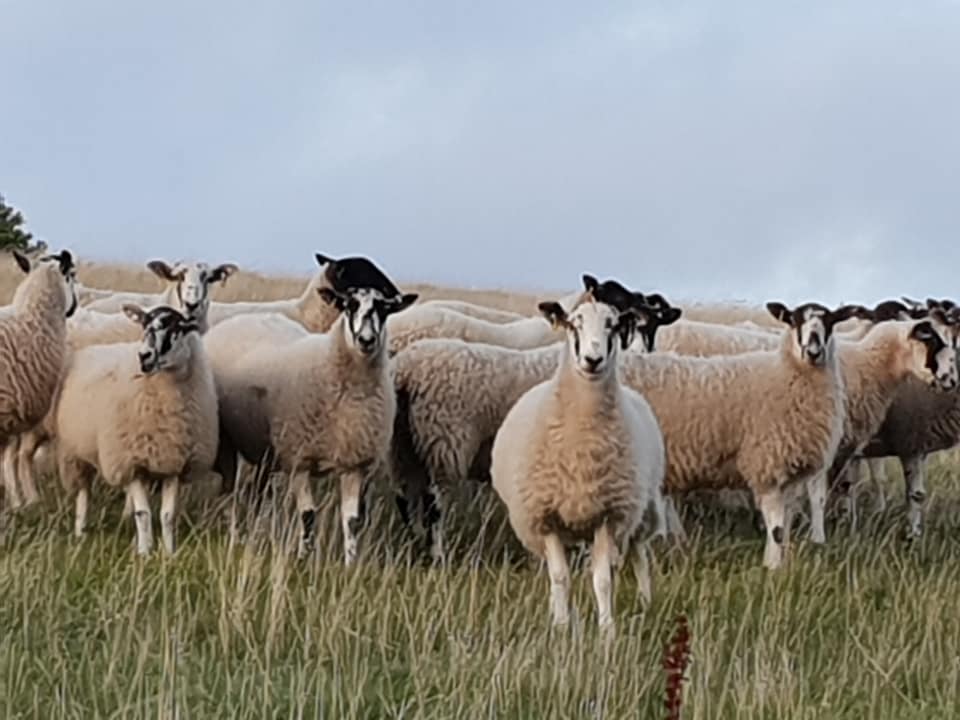
As Henry strode forward he was soon passing through the remnants of an abandoned village that disappeared as the villagers departed the land and the sheep took over the ancient fields. The tell tale depressions in the ground and the slightly raised level platforms of land reveal where the cottagers huts and buildings once stood, and slight linear depressions in the fields revealed where the village lanes ran throughout the settlement. Occasionally a wall of a crumbled village church would stand proud from the ground, standing testament to the earlier inhabitants of these bleak and windswept landscapes.
Henry continued along a sunken Holloway and was soon approaching the remains of an ancient cemetery. The graveyard had not been tended for centuries and most of the bodies had been exhumed and transferred to a charnel house when the land was ripped from the villagers grasp to make way for the flocks of sheep which miraculously turned the Lord of the Manors grass pastures and hill slopes to gold.
It was rumoured by many old-timers in the town below, that the ancient graveyard had included those who had perished during the numerous episodes of the Black Death or Plague that had ravished the country during the centuries that the village flourished. Indeed, an analysis of the soil would still show traces of the caustic lime that was spread over corpses that had perished from the Plague. These lime pits were often some way from an area of habitation, and this was why the graves were located further from the abandoned village than any other buildings.
Pausing a short while to glance back down the hill, Henry trudged upwards towards a small clump of trees that offered some shelter from the rain that had started to fall more persistently. Henry was starting to notice that there was a chill in the air and for a moment a tingling sensation ran the length of his body, from head to toes, resulting in a shake of his head and the hunching of his shoulders. His hobnail boots were not waterproof and his feet were starting to feel uncomfortably wet due to a combination of leakage and sweat. The loose fitting boots were also rubbing against his toes and heels and a trickle of blood was mixing with the sweat and rain water to stain his linen socks a dark red. Sucking in his cheeks he began to breath heavily due to his quickened pace as he tried to reach the shelter of the copse before the rain fell any harder.
Minutes later he was under the branches of a large Ash tree and washing the rain from his face with a handkerchief that he recovered from his waistcoat pocket. As he regained his composure he suddenly felt the presence of somebody or something behind him. Frozen to the spot and unable to move, his mind was flashing through various thoughts as to how he should react, because he was certain that an entity of some kind was behind his left shoulder. As if immobilised, he was at first unable to make his body respond to his brains signals. Moments later he spun his neck and head to his left and jumped back a stride as he turned to face the presence he sensed behind him.
Standing about three yards from him, only slightly obscured by the branches of a small conifer sapling, appeared to be the figures of a huge black wolf and a hooded figure with a shepherds crock in its left hand. Henry was startled by the vision before him but as the blood began to flow back in to his limbs and his brain regain some composure, he reached out to the apparition exclaiming "who are you and where have you come from ?"

After a brief pause the entity responded by stating in a strongly accented speech that he was in the service of his lord Offa, King of the Mercian's, and that he was to lead Henry to his destiny and salvation..........
As Henry followed the monk-like figure and wolf, he noticed that although it was still raining quite heavily, they were leaving no trail in the grass. Suppressing an urge to flee, Henry continued after the duo and quickened his pace so as to get closer to them.
However, each time he extended his stride and energetically increased his speed, he was unable to close the gap between himself and those he pursued. After a short time the hooded figure stopped and turned to Henry Reaper and gestured for him to come closer.
The monk grabbed Henry by his arm and pulled him gently towards him. Pointing towards a slight dip in the hillside, he declared that within a sacred glade hidden behind the depression in the hill was an entrance to a secluded valley that had been undisturbed for centuries. This valley contained an ancient monastery that had escaped the destruction and dissolution conducted by Henry Tudor, known to history as King Henry VIII, and his conniving principle secretary and chief minister, Thomas Cromwell.
Unable to respond in a coherent manner, Henry Reaper gestured to the monk to continue towards the supposed opening in the hillside so that they may proceed to the lost monastery. The mist and damp atmosphere grew thicker and before Henry was able to draw more than a few breaths, they were standing in the bright sunlight at the head of a gentle valley dominated by a huge Romanesque monastic structure, with its gleaming towers stretching in to a cloudless sky. Various outbuildings were scattered about the complex and farm animals were abundant in the fields adjacent to the monastic complex.
Soon they were seated at a table within the scriptorium where the monk disclosed his name as Aethelwulf of Ockendon and that the monastery was the seat of a particular knowledge endowed on only a few selected clerics and churchmen. He went on to explain events that had happened during the reign of Henry Tudors father, also named Henry, who as the victor of the battle of Bosworth, had seized the throne from the Yorkist claimant, Richard Plantagenet on behalf of the Lancastrian contingent of the Royal family. After gaining the throne, Henry VII had instigated the exploration of the north Atlantic by Bristol based sailors, so as to search for the fabled north west passage and to satisfy the need for new and fresh cod fishing grounds.
Aethelwulf the monk then explained that during one of these expeditions, a number of Bristolian families were put ashore on the North American coast to the south of Newfoundland and that they helped to found a settlement that has since been hidden from history. The members of this settlement flourished, and in time after interbreeding with the local indigenous people, eventually made unexpected contact with surviving members of previous voyages from Europe.

The welsh monks had travelled across the North Atlantic in small coracle like vessels and had survived the long and arduous journey by using the western isles, Iceland, Greenland and eventually the coast of Labrador and Newfoundland as stepping stones for obtaining fresh food and water. When they eventually made land fall on continental North America they were surprised to encounter the descendants of Norse explorers who had settled firstly in the more northern latitudes of Greenland and Newfoundland, and then abandoning there Vinland settlements had moved south to the more temperate climes of what was later to become New England.
Aethelwulf went on to disclosed that his ancestors were related to those who had settled in the lush forests and river valleys of the proto New England, and that he was a product of the mixing of the Welsh Monks, Norsemen, native indigenous inhabitants and Bristolians, who had come together to form a new community of nations in the new lands they now occupied. In time, the religious faction from Wales came to control the community that flourished under there strict and religious administration.
Realising that there was no future for them unless they revoked their vow of celibacy, they took native maidens as wives and reproduced in numbers sufficient to maintain there dominance. The descendants of the adventurers from Bristol soon became the communities merchant class, trading prodigiously with the native inhabitants, and the Norse quickly established themselves in the vanguard as the protectors of the community by forming a militia to police and defend the settlement of "Ockendon".
Aethelwulf then explained that although the North American community had remained hidden from the other inhabitants of North America, and continued to flourish it the Kingdoms hidden location deep within the forested hills of Arcadia, the wish to return to their homeland in Europe eventually overcame the benefits of their local paradise, and a band of warriors and there kin folk returned to the ancient lands of Mercia to establish a new community in the Insular Isles of Britain.

The location remained hidden from the local inhabitants due to a mysterious power that emanated from a casket of relics that included a magnificent Dagger. The current leader of this Angelcynn commonwealth was Offa, who had taken his name from his illustrious ancestor and King of Mercia.
Drawing a deep breath, Aethelwulf then drew a jewel encrusted dagger from a hidden pocket in his habit, and placed it before Henry Reaper exclaiming that his and his worlds destiny would soon be revealed and that he was to take the dagger in his hands and hold it towards the sky.
Offa , King of New Mercia, had been a ruthless ruler and was feared by the other sub Kings and Aethelings who inhabited the remaining hidden medieval enclaves of the Insular Isles.
The magical power of the "sacred casket" continuing to protect and hide the community from the present day Tudor and Stuart inhabitants of the lands.
It was to his utmost surprise that Ceolwulf, Osberht and Aethelbald had disobeyed his direct orders not to venture beyond the boarders of New Mercia, and had ravaged and harried the hidden scattered settlements of Bern Umbria, Dail Strath and Umbria, which although protected by the magical powers of the sacred casket, were at more risk as the magical powers weakened on the edges of the hidden new Saxon settlements.
The location of his hidden Kingdom would only remain hidden if a strict set of rules were followed by the Angelcynn hoard who inhabited the scattered settlements. However, the action of Ceolwulf and his cohorts had endangered the very survival of Offa's kingdom, and could lead to its and its related communities ultimate and permanent destruction.

Aethelwulf and Henry Draper entered King Offa's encampment and sat before the jewel encrusted dagger that had been carefully placed on a large solid wooden table. King Offa reached down to his side and lifted a casket of relics on to the table in front of them. Amongst the relics was a large golden door key, with a scarlet cord attached to its shoulder.
Henry motioned towards the glittering key and asked the King of its significance. Offa looked at Henry with a fixed stare and whispered that that it itself was the fundamental means to an eternal life within the isles.
He went on to describe a hidden hallowed temple, that contained a vault that could only be opened by the golden key, but with the proviso that it had to be held by someone with direct links to the Saxon pantheon of Gods and had the blood and DNA of the gods flowing through his veins and arteries.
Offa was in full reverent verse about the sacred vault when the three princess who had earlier disobeyed the Kings orders not to raid the sub states neighbouring the Kingdom burst in to the room. Ceolwulf gained his breath first and exclaimed that ships had been sighted in the estuary beyond the hills and that a raiding party of some two hundred vessels was swiftly making headway against the outgoing tide. Although it could not be certain, he believed that the invading hoard were bearing the standard of a legendary warrior who had been discussed in saga's and folk law for decades, but who's authenticity was often doubted by those in authority.
Offa immediately signalled to his underlings that they were to muster there forces and go with an emissary to meet with the invading hoard at a point far away from there secluded encampment and settlement. Ceolwulf, Osberht and Aethelbald sped away and briefly stopped in there tracks to ask Offa if he believed that the invaders were actually led by mysterious warrior from the saga's of the mead halls.
With this Offa stood tall in his leather and fur boots and cried that it was indeed "Gruffyd Brenin" the Welsh high King of the "Arcadian" lands that there ancestors had settled scores of years before, and that he had come home to claim his rightful pace as high king of the sacred isles.
To be continued.....


